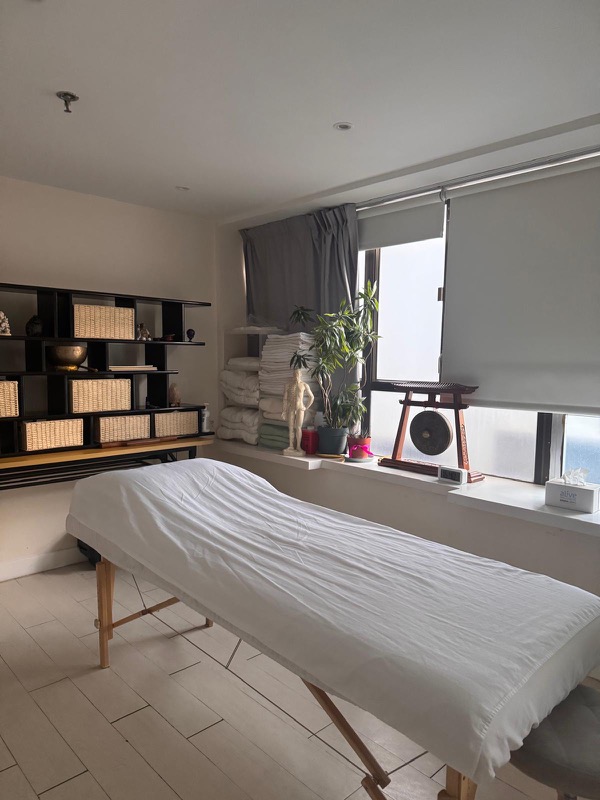
The first time I lay on a treatment table during training, I counted the ceiling tiles.
I know exactly how many there were. Twelve. I'd gotten to twelve before I realised I was doing it. The mental inventory thing, the quiet busy-ness I'd perfected over years of being the kind of person who manages. Who handles. I was in a training room with another student's hands resting very lightly under my occiput, and I was counting ceiling tiles.
Nobody told me it would feel like that. Like being asked to stop treading water when you hadn't realised you were doing it.
This is what biodynamic craniosacral training actually looks like from the inside: you work on each other. You spend as much time being the client as being the practitioner. You show up, swap, lie down, sit up, try to learn something while also being undeniably, uncomplicatedly in your body. Which, it turns out, is not something I was as comfortable with as I'd thought.
I came into this having done a lot of personal work. Therapy. Somatic stuff. I'd had CST sessions before; that's part of why I wanted to train. I knew, in the way you know things intellectually, that the body holds things. I could have told you that in a sentence. What I couldn't have told you, and didn't know, was how different it feels to be held quietly by someone learning to listen, versus being held by someone who's been doing this for twenty years.
With an experienced practitioner, there's a certain ease on both sides. In training, neither person is quite sure. And somehow that uncertainty made it harder to hide.
There was a session (I won't say when or with whom; it was mid-training, I was tired, I'd been on the ferry since early morning) where something shifted in a way I hadn't given it permission to. My training partner's hands were doing almost nothing. That's the thing people don't understand from the outside: the touch is so light it barely registers as touch. And yet something in my system just... let go of something. I felt it before I had words for it. Actually, I never quite got words for it. There was a sensation of something very old deciding it didn't need to stay braced anymore.
I cried, and I hadn't planned to, and I was annoyed at myself for crying, which made the whole thing take longer.
What surprised me most about the training wasn't the technique. It was how much resistance I had to being on the receiving end, and how much that taught me.
I'd spent the better part of a career being good at things. Being competent, being useful, producing something. Lying on a table and doing nothing useful is actually a skill I did not have. The impulse to manage the session from the inside (to help, to perform relaxing, to have interesting things happen that would be useful data for my partner) was constant. I kept having to notice it and put it down.
I also kept wanting to know what was happening. What they were feeling. What it meant. The practitioner part of my brain would not shut up. And that, I think, is where the real training happened. Not in the hours I spent with my hands on someone else, but in the hours I spent learning to just be there, on the table, not explaining anything, not helping, not making it neat.
There's something in the tissue that talking can't reach. I believed that before I started training. I believe it more now, but differently. Not as a principle but as something I've experienced being true from the inside. The thing that moved in that session mid-training didn't move because I understood it. It moved because I finally, reluctantly, stopped trying to.
I don't think I'm especially good at receiving, even now. I notice I'm still a little better on the giving side. More comfortable there. I understand what's being asked of me.
But I think about that room a lot. The ceiling tiles. The moment I realised I was counting them. The particular quality of stillness in a room where someone is trying to listen to your body more carefully than anyone usually does, including you.
If you've ever been in a session and felt the strange discomfort of being attended to (like something in you wants to perform okayness, or help things along, or at least be interesting), I want you to know I know exactly what that's like.
That impulse is not a problem. It's actually kind of the whole thing. It's the pattern saying hello.
What you do next is up to you.