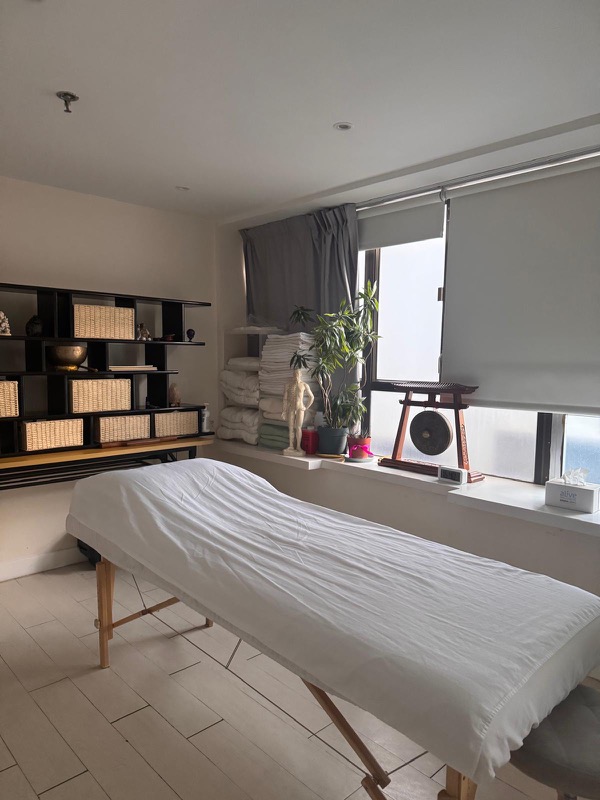
Central, Hong Kong
Somatic Experiencing (SE) is a body-based approach to trauma and nervous system healing developed by Dr. Peter Levine. Based in Central, Hong Kong, Faith Lantz brings SE-informed work into her craniosacral therapy practice, helping clients complete what the body has been holding, sometimes for a very long time.
Begin a conversation →
At a Glance
"SE works with the body's incomplete survival responses: the activation that began but never finished."
Origins
Peter Levine didn't set out to create a therapy. He set out to understand why animals rarely get traumatised, and what that means for humans.
Levine holds doctorates in both medical biophysics and psychology. Early in his career he worked with NASA on stress research. He studied under the ethologist Nikolaas Tinbergen, who received the 1973 Nobel Prize in Physiology or Medicine, and whose Nobel lecture explicitly addressed psychosomatic connections. He was also shaped by the bodywork traditions of Wilhelm Reich and the Gestalt therapy of Fritz Perls.
The founding insight: Levine observed that animals in the wild (prey animals especially) face life-threatening danger constantly, yet rarely develop lasting trauma. When a gazelle escapes a cheetah, it shakes and trembles, then returns to grazing. It literally shivers off the activation. Humans possess the same neurobiological equipment, but our capacity for thought and social inhibition means we often interrupt that discharge process. "I have to hold it together." The activation stays incomplete in the body.
The defining clinical moment: Early in his career, Levine worked with a woman named Nancy who entered a severe trauma response. Following an intuition he could not explain, he said: "You are a large cat, a tiger." Her body began to move, mobilising in a way that had been frozen. What followed was a full completion of the defensive response, then calm. He spent decades researching why that worked.
Waking the Tiger: Healing Trauma
Translated into over 30 languages. The book that made SE accessible to a general audience: a genuine reckoning with trauma as a biological event, not a psychological weakness.
In an Unspoken Voice: How the Body Releases Trauma and Restores Goodness
The comprehensive treatment of the neuroscience and full clinical framework. Where Waking the Tiger opens the door, this book furnishes the room.
Trauma and Memory: Brain and Body in a Search for the Living Past
On implicit body memory and how it stores and replays traumatic experience, and what this means for how we work with it therapeutically.
SE International is the training organisation Levine founded, based in Boulder, Colorado. The full SE practitioner training is a 216-hour, three-year programme moving through Beginning, Intermediate, and Advanced levels. It is one of the most thorough somatic training curricula available.
Core Concepts
SE doesn't ask the body to perform or push through. It asks the body what it's still holding, and creates the conditions to finish it.
When a threat response activates but can't complete (fight, flight, or freeze that couldn't resolve), the activation stays in the nervous system as unresolved charge. SE helps finish what couldn't finish then.
Working with small amounts of activation at a time. Moving slowly toward difficult material, then back. The opposite of cathartic re-experiencing. The pacing is the treatment. This is what prevents retraumatisation.
The natural oscillation between activation (charge) and settling (discharge). A healthy nervous system does this spontaneously. SE supports and restores this oscillation when it has become fixed at one pole.
Establishing a foundation of felt safety before approaching difficult material: internal sensations of stability, remembered experiences of support, the body's own capacity for rest. The anchor before the exploration.
Levine's framework for tracking five channels: Sensation (body) · Image (visual) · Behavior (movement, posture) · Affect (emotion) · Meaning (cognition). SE works primarily through the Sensation and Image channels, below the level of story.
A term from philosopher-therapist Eugene Gendlin. The vague, holistic, initially unclear body-sense of a situation. SE tracks the felt sense rather than the narrative. The body knows something before the mind can put words to it.
Sympathetic activation (fight/flight) and dorsal vagal shutdown (freeze/collapse/faint). SE works with both, not as pathology but as intelligent biological responses to overwhelming experience. The nervous system isn't broken. It is doing exactly what it learned to do. SE creates the conditions for it to learn something new.
"The body is not the problem. The body is the solution, if we know how to listen to it."
Orienting insight · the work of Peter Levine
Research
SE is grounded in four decades of neuroscience research. Here is the evidence base: what it shows, and where it is still building.
Polyvagal Theory: Neurophysiological Foundations (Norton, 2011)
Porges mapped a three-level hierarchy in the autonomic nervous system: ventral vagal (social safety and engagement), sympathetic (fight/flight), and dorsal vagal (freeze/shutdown). This provides the neuroanatomical foundation for SE's model of trauma responses, and explains precisely how safety and social connection facilitate recovery.
The Body Keeps the Score (Viking, 2014)
Neuroimaging at Boston University showed that during trauma recall, Broca's area (the brain's speech production centre) goes offline. The right-brain, body-based systems carry the load. Trauma is a body memory, not primarily a narrative one. Van der Kolk has explicitly endorsed somatic approaches as first-line interventions.
The Emotional Brain (Simon & Schuster, 1996)
Demonstrated the amygdala's role in implicit fear memory: emotional responses conditioned below conscious awareness. SE works directly at this implicit, procedural level, bypassing the need to narrate or cognitively reprocess events stored before language could reach them.
Somatic Experiencing for Posttraumatic Stress Disorder: A Randomized Controlled Outcome Study
Randomised controlled trial with 63 PTSD patients. The SE group showed significantly greater reduction in PTSD symptom scores compared to waitlist control. The first rigorous RCT on SE, and a methodologically significant step for the field.
Somatic Experiencing: Using Interoception and Proprioception as Core Elements of Trauma Therapy
Review paper linking SE's clinical mechanisms to polyvagal theory and neurobiological research. Provides the theoretical grounding for why SE works and how it integrates with mainstream trauma neuroscience.
SE-based psychotherapy for traumatised refugees
Significant reductions in PTSD and depression symptom severity in a refugee population, extending SE's evidence base beyond acute single-incident trauma to complex developmental and displacement contexts.

An honest note on the evidence. SE research is growing. Early studies have limitations in sample size and lack of active control conditions; the 2017 Brom RCT is a significant step toward rigorous evidence. The theoretical framework is well-developed and well-integrated with mainstream trauma neuroscience. The gap, where it exists, is in large-scale randomised trials, not in clinical experience or mechanistic understanding.
The Deeper Frame
Beneath the science, SE holds a clear premise: trauma is not the last word. The body always retains the capacity to complete what was interrupted.
Levine's orientation is fundamentally non-pathologising. Trauma symptoms are not signs of a broken nervous system. They are signs of a nervous system doing its best to protect itself from something overwhelming. The diagnosis is not failure; it is intelligence, frozen mid-motion.
Completion as healing. The insight at the heart of SE is that healing is not about adding something or fixing something broken. It is about allowing what was interrupted to find its natural conclusion. The gazelle shakes and goes back to grazing. The human body can do the same, given the right conditions and a steady enough witness.
"Resilience is not a character trait. It is a biological capacity. Every nervous system, given the right conditions, can move toward it."
Core premise · SE International training
The body as guide. SE reverses the conventional therapeutic hierarchy where the mind directs and the body executes. In SE, the body leads. The practitioner follows. This requires a particular kind of humility: not knowing in advance what the body will reveal, or when.
This is also Faith's orientation: approaching the work with reverence for what she doesn't control. The nervous system leads. She listens. Not technique, listening. The body already knows the way; the work is simply to stop getting in its way.
The Practitioner
SE-informed work woven into the body. Not delivered as a separate modality, but present in every session as a language for tracking what the nervous system is doing.
Training. Faith completed the full SE International curriculum: Beginning, Intermediate, and Advanced levels. 216 hours over three years — one of the most thorough somatic training tracks available.
Integration with craniosacral therapy. Faith combines SE-informed work with craniosacral therapy (Upledger Institute). In practice, the two complement each other closely. CST creates the body-settling container, the physical quieting that allows the nervous system to feel safe enough to begin completing its unfinished business. SE provides the language and framework for tracking what that nervous system is doing within that container.
SE is not delivered as standalone talk-based sessions. It is woven into bodywork as a body-aware language, informing what Faith tracks, how she paces the session, when she pauses and stays.
Who she works with. Adults with chronic stress, burnout, anxiety, developmental and acute trauma, freeze patterns, and chronic physical symptoms. Mothers postpartum. Babies and newborns, with CST as the primary modality and SE-informed throughout.
Location. Central, Hong Kong. Address confirmed on enquiry.
Applications
SE is not limited to a single type of trauma. Anywhere the nervous system is carrying something it couldn't finish, SE has something to offer.
Patterns formed early, often before language. The nervous system shaped itself around what wasn't safe, and it's still shaped that way.
Accidents, medical procedures, sudden loss, assault. A specific event that the system couldn't fully process at the time.
When the nervous system has been running hot for so long it no longer knows how to come down. Exhaustion that rest doesn't cure.
The exhaustion that sleep doesn't touch. Numbness. Disconnection. Dorsal vagal shutdown that has become a resting state.
Chronic alertness. The threat signal that won't quiet. Often no identifiable cause, because the cause is in the body, not the present moment.
Chronic pain, tension, digestive disruption, and other physical presentations with a nervous system component. The body carrying what the mind couldn't.
Patterns in relationship rooted in early experience: how we move toward people, how we pull away, what feels safe, what doesn't.
Support for mothers postpartum. And for babies and newborns, with CST as the primary modality and SE-informed throughout. Early nervous systems need tending too.
What to Expect
Sessions are quiet, unhurried, and interior. People are often surprised by how significant the changes feel relative to how undramatic the process was.
What's present today, where you are, what you're noticing in the body before we start. Not intake, just orientation. Setting the ground before we move.
Some sessions are purely body-aware and verbal, with no touch. Most combine SE-informed awareness with craniosacral touch. You stay fully clothed. The pace is yours.
What you notice, where it lives, how it moves. Not analysis, just noticing. The felt sense rather than the story. This is the primary language of the work.
Titration: small steps toward activation, with full permission to return to settling at any moment. The pacing is the treatment. There is no pushing through.
Time to settle before you leave. The changes often continue in the days after, as the nervous system keeps processing. You may want space and quiet after a session.
SE sessions are not dramatic or cathartic. The work tends to feel quiet and interior: subtle shifts, images that arise and dissolve, sensation moving through the body. People are often surprised by how significant the changes are relative to how undramatic the process felt.
Questions
If you're wondering whether SE is right for you, these are the questions people ask most.
No. SE is as relevant for chronic stress and burnout as it is for acute trauma. The nervous system doesn't distinguish between "big T" and "little t"; it responds to whatever felt overwhelming at the time. Developmental patterns, relational wounds, chronic overload: all of these leave residue in the body. You don't need a defining event to benefit from this work.
Not in detail, and often not at all. SE works below the level of story. The body holds the experience; the body is where we work. You might name what's present in broad strokes, but you won't be asked to narrate or re-experience events. Many people find this a real relief. The healing doesn't require revisiting the event in graphic detail.
No. Both are somatic and trauma-focused, but the approaches differ significantly. EMDR uses bilateral stimulation (typically eye movement) to help process traumatic memories, and it tends to engage memory more directly. SE works primarily through body sensation and the felt sense, tracking the incomplete survival response rather than the memory itself. SE tends to be slower and more titrated; EMDR can move more quickly through specific memories. Some practitioners integrate both.
Faith has completed the full SE International training: Beginning, Intermediate, and Advanced levels — a 216-hour, three-year programme. She brings SE as an integrated, body-aware framework into her sessions alongside Upledger craniosacral therapy. All SE-informed work is delivered within that bodywork context, woven into sessions rather than offered as standalone SE therapy.
Yes, and this is often where SE is most useful. Anxiety without a clear narrative cause is frequently anxiety with a body cause. The threat signal is real; it simply doesn't belong to any present situation. It belongs to something the body is still holding from before. SE doesn't require a story to work with. It works with what's happening in the body right now, and the body will usually reveal what it needs to.
They are deeply complementary. Craniosacral therapy (CST) works directly with the nervous system through very light touch on the skull, spine, and sacrum, supporting the body's own healing movements. This creates a quality of settling and safety in the body that SE can then work within. CST quiets the system; SE tracks what the newly quieter system begins to reveal. In practice, the two are not always distinguishable. They function as one integrated approach.
It varies significantly. Some people feel a clear shift after two or three sessions. Others come regularly for months, or return periodically over years. There is no formula. What Faith can say honestly is that this work rewards continuity. The nervous system builds trust over time, and what becomes available in the sixth session is often very different from what was available in the first.
The best thing to do is begin, notice how your body responds, and let that guide the pace.
Yes. Faith works with newborns and babies using craniosacral therapy as the primary modality, SE-informed throughout. Birth can be one of the earliest events the nervous system holds. Even uncomplicated births involve significant physical intensity for both baby and mother. CST for infants is very light, responsive, and effective for settling and regulation.
Faith also offers postpartum support for mothers, a period when nervous system care is particularly needed and often overlooked.
Central, Hong Kong
Send a message on WhatsApp. Tell me what's brought you here, or simply that you'd like to know more.
Message on WhatsApp →